
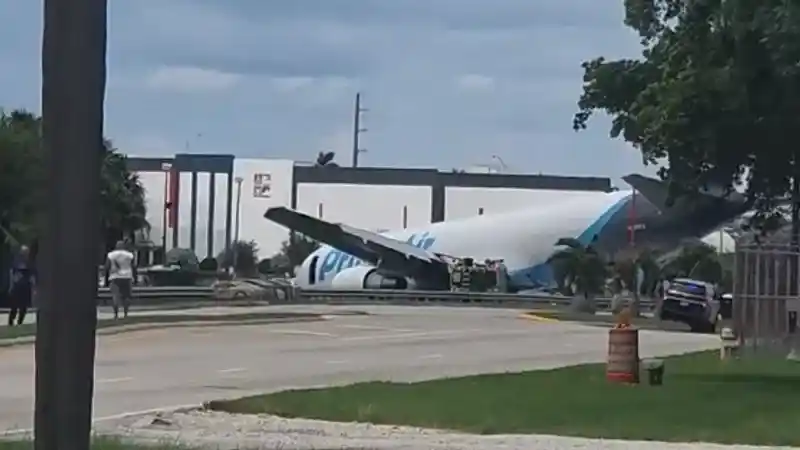
The Amazon cargo plane crash in Miami has become one of the most serious aviation accidents in the United States in 2026 after a Boeing 767-300 freighter overran a runway at Miami International Airport, struck multiple vehicles and caught fire. Five people were killed and five others were injured, including three who were reported to be in critical condition, according to local officials.
The accident happened Sunday, September 6, 2026, at approximately 2 p.m. local time as Amazon Prime Air Flight 7598 arrived at Miami International Airport from San Juan, Puerto Rico. The aircraft was operated by 21 Air on behalf of Amazon. The Federal Aviation Administration confirmed that the Boeing 767-300 cargo plane overran the runway after landing.
The Miami International Airport plane crash prompted a massive emergency response, with more than 60 Miami-Dade Fire Rescue units sent to the scene. Firefighters battled flames while rescue crews searched the aircraft and vehicles that had been struck.
Federal investigators are now working to determine what caused the Amazon cargo plane to leave the runway and whether factors involving the aircraft, runway, weather or landing contributed to the deadly accident.
Amazon Cargo Plane Crash in Miami Leaves Five Dead
The deadly Amazon plane crash in Miami occurred as Prime Air Flight 7598 was landing at Miami International Airport after traveling from San Juan’s Luis Muñoz Marín International Airport.
According to the FAA, the Boeing 767-300 overran the runway around 2 p.m. The aircraft then struck multiple vehicles outside the runway area before coming to a stop and catching fire.
The crash created a dangerous and chaotic scene around the airport. Thick black smoke could be seen rising from the area as firefighters and emergency personnel rushed to the scene.
Miami-Dade Fire Rescue said more than 60 units responded to fight the fire and assess injuries. Emergency crews also faced the difficult task of reaching people trapped inside vehicles and the aircraft.
Authorities later confirmed that five people had died and five others were hospitalized. Three of the injured were in critical condition, while two others suffered less serious injuries. Officials had not immediately released the identities of those killed.
What Happened to the Amazon Plane in Miami?
The aircraft involved in the Miami Amazon cargo plane crash was a Boeing 767-300 freighter operated by 21 Air for Amazon’s Prime Air operation.
The plane had departed from San Juan, Puerto Rico, and was approaching Miami International Airport when it landed and continued beyond the usable runway area. The aircraft subsequently crossed beyond the airport runway environment and struck several vehicles.
Reuters reported that the aircraft came to a stop with visible damage and scorch marks after the runway excursion. Emergency crews also continued dealing with a fuel leak at the scene.
The pilot and co-pilot were among those trapped in the aircraft after the crash, while people on the ground were also caught in the accident.
The exact sequence of events remains under investigation.
That means it is still too early to say whether the crash was caused by a mechanical problem, pilot action, runway conditions, weather or another factor.
Boeing 767-300 Cargo Plane Was Operated by 21 Air
Although headlines have referred to the aircraft as an Amazon cargo plane, the Boeing 767 was operated by 21 Air, a North Carolina-based cargo carrier.
Amazon uses contracted air carriers as part of its Prime Air transportation network. In this case, 21 Air was operating the flight on Amazon’s behalf.
Amazon confirmed the accident and said the company was working closely with local authorities and officials.
The company also expressed sympathy for the victims and their families while emphasizing that its immediate priority was supporting those affected by the crash.
The distinction between Amazon and the operating carrier is important when reporting the accident because the aircraft was part of the Amazon Air network but was not being operated by Amazon’s own pilots.
Five People Were Killed and Five Were Injured
The human toll is the most devastating part of the Amazon cargo plane crash in Miami.
Five people lost their lives, while another five people were injured and transported to hospitals.
Three of those injured were reported to be in critical condition. Authorities were still working to determine the circumstances surrounding the victims when the first reports were released.
Emergency crews faced a particularly difficult rescue operation because the aircraft struck vehicles outside the runway area.
Miami-Dade Fire Rescue Chief Ray Jadallah described the response as complex. Crews had to fight the fire, deal with a fuel leak and rescue people trapped in damaged vehicles and inside the aircraft.
The identities of the five people who died had not yet been publicly released in the latest reports.
Officials also had not immediately clarified whether all of the fatalities occurred among people on the ground or whether any were connected to the aircraft.
More Than 60 Fire Rescue Units Responded
The scale of the emergency response shows how serious the Miami airport plane crash was.
More than 60 Miami-Dade Fire Rescue units responded to the scene, with firefighters working to control the flames while rescue teams assessed the aircraft and surrounding vehicles.
The plane’s fuel created another hazard for emergency personnel.
Crews had to work around damaged vehicles, aircraft debris and fire while attempting to locate and rescue people who were trapped.
The emergency response continued for hours after the crash.
The incident also required airport authorities and federal aviation officials to temporarily halt normal airport operations.
Miami International Airport Ground Stop Causes Major Delays
The Amazon plane crash at Miami International Airport caused significant disruption to flights.
Following the accident, authorities issued a ground stop that temporarily halted airport operations while emergency crews responded and officials assessed the situation.
The disruption affected both arriving and departing flights.
According to the Associated Press, the crash resulted in more than 160 flight cancellations and approximately 325 delays. Normal operations later began returning as portions of the airport reopened.
Travelers flying through Miami were advised to check their flight status directly with their airlines because delays and cancellations could continue as airport operations recovered.
Miami International Airport is one of the country’s major aviation hubs, making a runway closure capable of affecting a large number of travelers and connecting flights.
NTSB Investigates Miami Amazon Plane Crash
The NTSB investigation into the Amazon cargo plane crash is now one of the most important developments to watch.
The National Transportation Safety Board has launched a team to investigate the runway excursion. The Federal Aviation Administration is also investigating the accident.
Investigators will examine the aircraft, flight data, cockpit communications, runway conditions, weather information and other evidence.
One of the central questions will be why the Boeing 767 was unable to stop within the runway area.
Investigators will likely examine the aircraft’s touchdown location, landing speed, braking performance and environmental conditions.
The NTSB may also investigate whether wind conditions played a role.
However, investigators have not identified a confirmed cause.
It is important to distinguish between facts that have already been established and potential explanations that are still being investigated.
Did Weather Contribute to the Miami Plane Crash?
Weather conditions are among the factors investigators will likely examine.
Early reports indicated that storms were in the area and that winds were present around the time of the accident. However, there is currently no official determination that weather caused or contributed to the runway overrun.
That distinction is important.
A weather condition can exist at the time of an aviation accident without necessarily causing the accident.
Investigators will compare weather observations, wind direction and speed, runway conditions and the aircraft’s performance to determine whether environmental conditions played any role.
Until the NTSB or another appropriate authority establishes a cause, claims about weather should be treated as preliminary.
Investigators Will Examine Why the Plane Overran the Runway
A major focus of the investigation will be the runway excursion itself.
A runway overrun occurs when an aircraft travels beyond the end of the runway after landing or during an aborted takeoff.
In Miami, the Boeing 767 continued beyond the runway area and struck several vehicles.
Investigators will want to know exactly where the aircraft touched down and how much runway remained at that point.
They will also examine how the aircraft’s braking systems performed and whether the crew took appropriate actions during the landing.
These details will be critical to understanding why the plane could not stop before reaching the end of the runway.
According to Reuters, investigators are examining the circumstances surrounding the runway overrun, while AP reported that questions could include whether the aircraft landed too far down the runway and whether wind conditions played a role.
Miami Airport Runway Safety Under Scrutiny
The Miami airport crash could also lead to renewed questions about runway safety.
The Associated Press reported that Miami International Airport does not have certain FAA-recommended arresting systems designed to help stop aircraft that overrun a runway.
The issue does not mean the lack of such a system caused this particular crash.
However, the investigation could examine whether additional safety infrastructure might have reduced the consequences if the aircraft left the runway.
Runway safety has long been an important issue in aviation because an aircraft traveling beyond the runway can encounter roads, buildings, vehicles or other obstacles.
The Miami accident demonstrates how quickly a runway excursion can become a mass-casualty event when people and vehicles are located beyond the airport’s runway environment.
How Old Was the Amazon Boeing 767?
The aircraft involved in the Amazon cargo plane crash was approximately 32 years old, according to reports.
The Boeing 767 was originally built as a passenger aircraft before being converted into a freighter in 2015.
The aircraft’s age is likely to generate questions among the public, but an airplane’s age alone does not establish that it was unsafe.
Cargo aircraft frequently remain in service for decades when they are properly maintained and comply with aviation regulations.
Investigators will therefore examine the aircraft’s maintenance records, mechanical systems and operational history rather than simply treating its age as evidence of a problem.
If investigators discover a mechanical issue, that finding would need to be supported by physical evidence and technical analysis.
Amazon Responds to the Deadly Crash
Amazon has expressed condolences to the victims and said it is cooperating with investigators.
Amazon spokesperson Kelly Nantel said the company was working with local authorities and officials to understand what happened and that the safety and well-being of those affected were the company’s immediate priority.
Amazon’s response is significant because Prime Air plays an important role in the company’s massive logistics network.
The company relies on air cargo operations to move packages and inventory throughout the United States and internationally.
However, the aircraft involved in Sunday’s crash was operated by 21 Air rather than directly by Amazon.
The investigation will therefore examine the operations of the flight, aircraft and carrier involved in the accident.
What Investigators Will Look at Next
The coming days and weeks will be critical for understanding the Miami Amazon plane crash.
Investigators will collect evidence from the crash site and examine the aircraft’s systems.
They will also review flight tracking information, communications between the pilots and air traffic controllers, weather conditions and runway information.
The aircraft’s maintenance and operational records will likely be examined as part of the investigation.
Investigators may also interview witnesses, airport employees, first responders and others who saw the aircraft during its approach or immediately after the crash.
The goal is to reconstruct the final moments of the flight as accurately as possible.
Only after reviewing that evidence will investigators be able to determine the probable cause and any contributing factors.
Why the Amazon Cargo Plane Crash Matters
The deadly Amazon cargo plane crash in Miami raises important questions about aviation safety, runway operations and emergency response.
Large cargo aircraft routinely operate at major airports across the United States. While commercial aviation remains highly regulated, runway excursions remain a serious safety concern because they can result in aircraft entering areas occupied by vehicles, airport workers or members of the public.
The Miami accident is especially significant because the Boeing 767 did not simply stop at the edge of the runway.
It continued beyond the runway, crossed into an area with vehicles and caused a fire that required a major emergency response.
The eventual findings from the NTSB could determine whether changes are needed in aircraft operations, airport infrastructure, runway safety procedures or other areas.
What We Know About the Miami Amazon Plane Crash
As investigators continue working at the scene, several facts about the Amazon cargo plane crash have been established.
Prime Air Flight 7598 was a Boeing 767-300 cargo aircraft operated by 21 Air. It was traveling from San Juan, Puerto Rico, to Miami International Airport when it overran a runway after landing around 2 p.m. Sunday.
The aircraft struck multiple vehicles and caught fire.
Five people were killed and five others were injured, including three critically.
More than 60 Miami-Dade Fire Rescue units responded.
The FAA and NTSB are investigating the accident.
The airport experienced a temporary ground stop and significant flight disruptions.
What remains unknown is why the aircraft overran the runway.
That question will be central to the investigation.
Final Thoughts on the Amazon Cargo Plane Crash
The Amazon cargo plane crash in Miami is a devastating aviation tragedy that has left five people dead, five injured and countless others affected by the consequences of the accident.
The Boeing 767-300 operated by 21 Air was landing at Miami International Airport after traveling from San Juan when it overran the runway, struck multiple vehicles and caught fire.
The massive emergency response demonstrated the seriousness of the incident, with more than 60 Miami-Dade Fire Rescue units working to extinguish the fire and rescue people from the aircraft and damaged vehicles.
For now, the cause of the crash remains under investigation.
The NTSB and FAA will examine the aircraft, runway, weather, flight data and other evidence to determine what happened during the landing.
As investigators work to reconstruct the accident, the priority remains the victims and their families.
The answers that emerge from the investigation will be important not only for understanding this Miami International Airport plane crash, but also for identifying whether additional safety measures could help prevent another runway accident from becoming a similar tragedy.
Sources / References
- The Wall Street Journal — Amazon Cargo Plane Overshoots Runway in Miami, Killing Five People
- Reuters — At least 5 killed in Amazon Prime Air cargo plane crash in Miami
- Associated Press — Investigators hunt for what went wrong after cargo plane crash in Miami
- Federal Aviation Administration — Aviation Accident Statements
- ABC News — 5 dead, 5 injured after Amazon cargo plane crashes at Miami airport
 Jenn Sass