
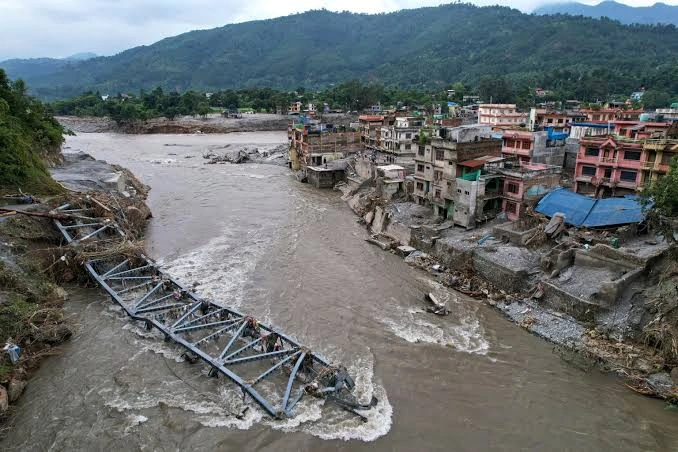
Nepal is facing one of the most devastating natural disasters in its recent history after catastrophic flash floods and landslides swept through communities along the Nepal-Tibet border, killing more than 800 people and leaving more than 3,000 missing. Rescue teams are racing against time to locate survivors, recover victims, and reach communities cut off by destroyed roads, landslides, debris, and continuing flooding.
The disaster began with a powerful flash flood in the Himalayan region, sending enormous amounts of water, mud, rocks, and debris through valleys and settlements. The destruction was particularly severe in Nepal’s Rasuwa district and areas near the border with China’s Tibet region.
What initially appeared to be a devastating but localized disaster has developed into a massive humanitarian emergency involving multiple communities, foreign travelers, hydropower workers, and residents on both sides of the border.
The death toll has continued to rise as rescuers reach previously inaccessible areas. Recent reports put the combined number of confirmed deaths in Nepal and Tibet at more than 800, while thousands remain unaccounted for.
For families still waiting for information about missing relatives, however, the numbers only tell part of the story.
Nepal Faces a Catastrophic Flood Disaster
The flooding struck on August 26 after a sudden surge of water swept through the Himalayan river systems.
The force of the water was extraordinary.
Homes, roads, bridges, vehicles, businesses, and other infrastructure were swept away or buried beneath mud and debris. Entire sections of communities were transformed within hours as floodwaters rushed through mountain valleys.
The disaster also affected important transportation and trade routes connecting Nepal with China.
One of the hardest-hit areas was near the Gyirong border crossing, where the force of the flood destroyed infrastructure and disrupted movement between Nepal and Tibet.
The damage has made rescue operations extremely difficult.
In mountainous regions, even normal travel can be challenging. After a major flood, the situation becomes significantly more dangerous as roads disappear, bridges collapse, and landslides block access routes.
Death Toll Continues to Rise
The death toll has changed rapidly as emergency teams reach areas that were initially inaccessible.
Earlier reports placed the number of deaths in the hundreds, but the latest figures have pushed the combined toll in Nepal and Tibet above 800. More than 3,000 people are still reported missing.
The numbers remain fluid because rescue workers are still searching through damaged communities and infrastructure.
Some victims were swept downstream by the floodwaters.
Others may remain buried beneath mud, rocks, or collapsed structures.
The difficult terrain and continued risk of landslides are making it harder for rescue teams to determine the full scale of the tragedy.
Authorities are also facing the difficult task of identifying recovered bodies and reconnecting them with their families.
Thousands of People Are Still Missing
The number of missing people has become one of the most troubling aspects of the disaster.
More than 3,000 people remain unaccounted for across Nepal and Tibet, according to recent reports.
Among those missing are local residents, hydropower workers, travelers, and foreign nationals.
The number of missing people is expected to change as authorities receive new information and rescue teams reach isolated areas.
In many cases, families have been unable to contact relatives because mobile networks and transportation systems have been disrupted.
That uncertainty is especially painful for families who know their loved ones were in affected areas but have no confirmation of whether they survived.
Hydropower Workers Trapped in Tunnels
One of the most urgent rescue operations is taking place at hydropower facilities.
Hundreds of workers are believed to be trapped inside tunnels blocked by mud and rock following the flood.
According to Reuters, approximately 933 hydropower workers are among those missing in Nepal. Rescue teams are working to clear tunnels and reach people who may still be alive underground.
The rescue operation is extremely dangerous.
Floodwaters can destabilize mountain slopes, while blocked tunnels can contain dangerous levels of water, mud, and debris.
Nepalese military personnel, volunteers, and specialists from neighboring countries are assisting with the response.
The operation has become a race against time because the chances of finding survivors can decline rapidly when people are trapped without access to food, clean water, air, or medical care.
More Than 21,000 Personnel Are Involved in the Rescue
The scale of the response demonstrates the seriousness of the disaster.
More than 21,000 Nepalese personnel, including military and volunteer teams, have been involved in rescue and relief operations.
Rescuers are working across difficult terrain while facing the continuing threat of additional flooding and landslides.
Helicopters have become particularly important because many roads have been destroyed or blocked.
Aircraft can reach isolated communities, transport injured people, deliver emergency supplies, and help rescue teams reach areas that cannot be accessed by road.
But helicopters also face challenges in mountainous terrain, especially when weather conditions deteriorate.
China and India Are Helping Nepal
The disaster has prompted international cooperation.
China has deployed more than 2,000 rescuers to affected areas on the Tibetan side of the border.
India has also provided assistance, with specialists helping Nepal with difficult tunnel rescue operations.
The international response is especially important because the disaster crosses a difficult border region.
Nepal cannot easily reach every affected location alone, while China faces its own rescue challenges in Tibet.
Cooperation between the countries is therefore essential to locating missing people and providing assistance to survivors.
The Disaster Has Affected Foreign Travelers
The tragedy has also involved foreign nationals who were traveling through the region.
The area is an important route for pilgrims and travelers heading toward Mount Kailash, one of the most significant religious destinations in the Himalayas.
Earlier reports indicated that hundreds of foreigners were among those missing following the disaster.
Travelers from countries including India, the United States, Australia, Britain, Canada, Malaysia, South Korea, and Japan were reported missing at different stages of the rescue effort.
The presence of international travelers has added another layer of urgency to the response.
Foreign governments are working with Nepalese and Chinese authorities to determine the whereabouts of their citizens.
Families around the world have been waiting anxiously for updates.
Roads and Bridges Have Been Destroyed
One of the biggest obstacles facing rescue workers is the destruction of transportation infrastructure.
Floodwaters and landslides have damaged or completely destroyed roads and bridges.
That makes it difficult to transport heavy rescue equipment, food, drinking water, medicine, fuel, and other necessities.
In some locations, emergency workers must travel on foot or use helicopters to reach isolated communities.
The loss of transportation infrastructure also creates long-term problems.
Even after the immediate emergency ends, rebuilding roads and bridges will be essential for communities to recover economically.
Nepal’s Mountain Geography Makes Rescue Difficult
Nepal is one of the world’s most mountainous countries, and its geography makes it particularly vulnerable to floods, landslides, and other natural disasters.
Steep valleys can channel enormous amounts of water into narrow areas.
When a landslide or glacier-related event occurs, the resulting debris can travel rapidly downstream.
That can give residents little time to react.
Mountain communities can also become isolated quickly when a single road or bridge is destroyed.
The same geography that makes Nepal famous for its spectacular landscapes can therefore create enormous challenges during disasters.
A Possible Glacier-Related Trigger
Scientists and authorities have been examining what triggered the catastrophic flooding.
Early assessments have pointed to a combination of glacier-related activity, landslides, and sudden water release.
Reuters reported that the disaster was linked to an ice avalanche-induced mudslide, while other scientific assessments have examined the role of glacier instability in the event.
Understanding the precise cause will be important for future disaster planning.
The Himalayas contain thousands of glaciers and glacial lakes.
When large amounts of ice, rock, or water suddenly move downhill, the resulting floods can be extraordinarily destructive.
Climate Change Raises Additional Concerns
The disaster has also renewed discussion about climate change and the vulnerability of Himalayan communities.
Scientists have warned that rising temperatures can destabilize glaciers and increase risks associated with glacial lakes and ice formations.
That does not mean climate change is the only cause of a particular disaster.
Natural geological processes, rainfall, terrain, and human development can all influence the severity of flooding.
However, changing temperatures are increasingly being studied as an important factor in Himalayan hazards.
For Nepal, this creates a difficult long-term challenge.
The country must prepare not only for traditional monsoon flooding but also for increasingly complex risks associated with a changing mountain environment.
Rescue Efforts Continue Despite Dangerous Conditions
Rescue teams are working under extremely difficult circumstances.
Fresh landslides can occur without warning.
Floodwaters can rise again.
Mud and debris can make buildings unstable.
Roads can collapse beneath vehicles.
And workers searching tunnels may face dangerous conditions underground.
Despite those risks, thousands of rescuers continue searching for missing people.
Their work has already resulted in thousands of survivors being rescued from affected areas.
The operation is likely to continue for some time because authorities must search large areas of damaged terrain.
Families Face an Agonizing Wait
For families of missing people, the rescue operation has become an emotional marathon.
Many relatives have spent days waiting for phone calls, official announcements, or information from rescue workers.
Some have traveled to hospitals and emergency centers hoping to find loved ones.
Others are communicating through social media and community networks to exchange information.
In disasters of this scale, communication can become almost as important as physical rescue.
Families need accurate information about evacuation centers, hospitals, transportation routes, and lists of survivors.
Without reliable communication, rumors can spread quickly and make an already traumatic situation even more difficult.
Temporary Burials Add Another Painful Challenge
The disaster has also created a difficult situation involving the large number of bodies recovered from affected areas.
In Nepal’s Chitwan district, authorities have faced limited morgue and forensic capacity as bodies were recovered downstream.
The Associated Press reported that hundreds of unidentified bodies were recovered and that authorities began temporary burials of some remains because of decomposition and health concerns.
The decision has generated criticism because of the importance of traditional Hindu funeral practices.
Officials have said the temporary burials are intended to protect public health while preserving identifying information that can later help families claim remains.
DNA samples, photographs, and other information are being collected to assist with identification.
For families, however, the process remains deeply painful.
Many want the opportunity to identify and properly bury their loved ones according to their traditions.
Nepal’s Government Faces a Massive Challenge
The disaster presents an enormous challenge for Nepal’s government.
Authorities must coordinate rescue operations, provide food and shelter, restore transportation, identify victims, assist survivors, and begin rebuilding damaged infrastructure.
At the same time, officials must communicate clearly with the public about the changing death toll and missing-person figures.
The government’s ability to manage the response will be closely watched.
Natural disasters can test the strength of any government, particularly when infrastructure is heavily damaged and large numbers of people require assistance simultaneously.
The Economic Impact Could Last for Years
The human cost is the most important concern, but the economic damage could also be enormous.
Flooding has damaged homes, businesses, roads, bridges, hydropower facilities, and tourism infrastructure.
Nepal relies heavily on tourism, particularly in mountain regions.
If roads and border crossings remain damaged, travel and trade could be disrupted for an extended period.
Hydropower is also an important part of Nepal’s economy.
Damage to hydropower projects could affect both employment and electricity generation.
Rebuilding these facilities will require significant financial resources.
Communities Will Need Long-Term Support
Emergency assistance is only the beginning of recovery.
Families who lost their homes will need temporary and eventually permanent housing.
Farmers may need help replacing livestock, equipment, and crops.
Businesses may require financial assistance to reopen.
Children whose schools were damaged will need alternative classrooms.
Communities will need roads, bridges, electricity, communications, and clean water restored.
That process could take months or even years.
The international community may therefore have an important role to play in Nepal’s recovery.
Nepal’s Disaster Preparedness May Face New Questions
The scale of the catastrophe is also likely to prompt questions about disaster preparedness.
Could earlier warnings have saved lives?
Were evacuation systems sufficient?
Did communities have access to emergency communication?
Were vulnerable hydropower facilities adequately protected?
Were enough resources available for mountain rescue operations?
These questions are not easy to answer during an unfolding disaster.
But they will become increasingly important once the immediate emergency ends.
The lessons learned could help Nepal prepare for future floods and landslides.
A Disaster That Crossed Borders
One of the most unusual aspects of the catastrophe is the way it has affected both Nepal and Tibet.
The flood did not stop at an international border.
Communities on both sides were affected, and rescue operations have required cooperation between neighboring countries.
China has its own missing people and casualties, while Nepal is dealing with an enormous number of victims and missing residents.
The situation demonstrates how natural disasters can create international emergencies.
Water, rivers, glaciers, and landslides do not follow political boundaries.
That makes regional cooperation increasingly important in the Himalayas.
The Humanitarian Crisis Is Still Developing
Although the worst of the initial flooding has passed in some areas, the humanitarian emergency is far from over.
Thousands of people remain missing.
Others have lost homes and livelihoods.
Some communities remain difficult to reach.
And rescue workers continue to face dangerous terrain.
The death toll could change again as more bodies are recovered and missing people are accounted for.
That means reports about the disaster should be treated as developing information.
Figures can change rapidly during large-scale emergencies.
What Happens Next?
The immediate focus will remain on finding survivors and accounting for the missing.
Rescue teams will continue clearing roads, searching tunnels, recovering bodies, and reaching isolated communities.
Authorities will also need to provide temporary housing, food, water, medicine, and psychological support to survivors.
As the emergency phase ends, attention will shift toward reconstruction.
Nepal will need to repair damaged infrastructure while also examining whether existing disaster-preparedness systems are adequate for future events.
The disaster could ultimately lead to major discussions about early-warning systems, glacier monitoring, emergency communication, mountain infrastructure, and climate resilience.
Why This Disaster Matters Beyond Nepal
The catastrophe is not only a national tragedy.
It is a warning for communities across the Himalayan region.
Millions of people live in areas exposed to flooding, landslides, glacier-related hazards, and extreme weather.
The disaster demonstrates how quickly a natural event can overwhelm infrastructure and emergency systems.
It also shows the importance of international cooperation.
Nepal, China, India, and other countries have had to work together to respond to a disaster that has affected travelers and residents from numerous nations.
The lessons learned from the response could influence disaster planning across the region.
Final Thoughts
Nepal is facing an extraordinary humanitarian crisis after catastrophic floods and landslides killed more than 800 people across Nepal and Tibet and left more than 3,000 people missing. Rescue teams are continuing to search for survivors while struggling with blocked roads, unstable terrain, destroyed infrastructure, and the continuing threat of additional flooding.
Among the most urgent rescue efforts are searches for hundreds of hydropower workers believed to be trapped inside tunnels buried by mud and rock.
The disaster has also affected foreign travelers, destroyed important transportation routes, damaged homes and businesses, and created a major challenge for governments on both sides of the Nepal-Tibet border.
For Nepal, the immediate priority is clear: save as many lives as possible, find the missing, care for survivors, and provide families with accurate information.
But once the rescue operation ends, the country will face another enormous task.
It will have to rebuild.
The disaster has exposed how vulnerable Himalayan communities can be to sudden floods, landslides, and glacier-related hazards. It has also raised difficult questions about climate change, infrastructure, emergency preparedness, and the need for stronger regional cooperation.
For the families waiting for missing loved ones, however, the most important story is still unfolding.
Every rescue matters.
Every recovered victim matters.
And every person brought home safely represents a small victory in the middle of one of Nepal’s darkest disasters in years.
Sources & References
- Reuters — Nepal teams seek hundreds trapped in hydropower tunnels after deadly floods
- Reuters — Rescuers battle floods and debris as Himalayan disaster death toll nears 800
- Reuters — Before flood catastrophe, Nepal asked China for early warnings as risks mounted
- Reuters — Glacier collapse may have triggered deadly Nepal flash flood, experts say
- Associated Press — Rescue efforts intensify after Nepal-Tibet flooding as deaths climb past 900
- Associated Press — Nepal warns of possible fresh flooding as communities grapple with devastation
- Associated Press — People from more than 30 countries are missing after the flash floods in Nepal and China
- Al Jazeera — Nepal-China floods: What’s the latest toll, how many are missing?
- CBS News — Nepal flood death toll reaches 800, with more than 3,000 missing
 Jenn Sass