
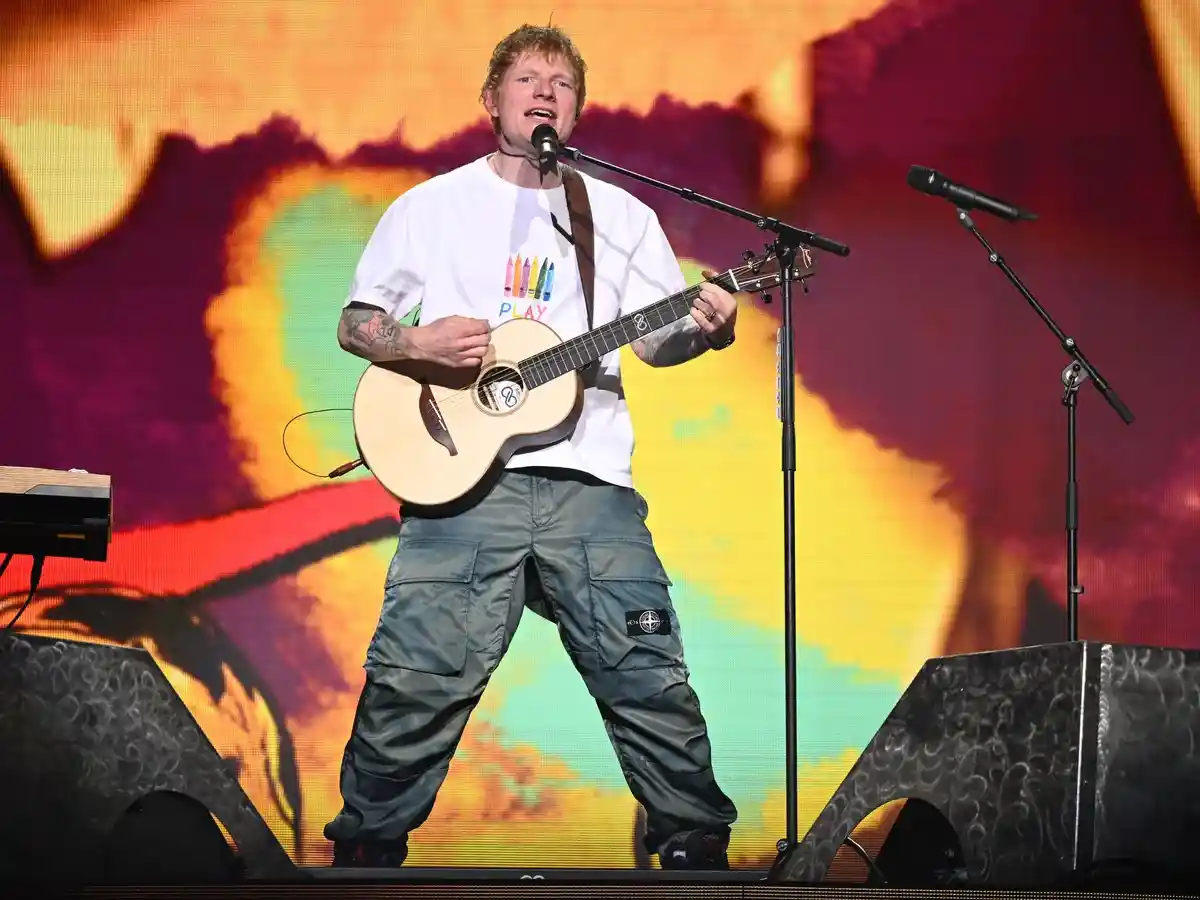
Celebrity involvement in politics is hardly a new phenomenon. From musicians performing at political rallies to actors campaigning for causes and athletes speaking publicly about social issues, entertainers have long used their visibility to influence public conversations.
Yet every time a famous singer, actor or other public figure makes a controversial political statement, the same debate returns: Should celebrities stay out of politics?
That question has resurfaced following controversy surrounding Ed Sheeran and rapper Macklemore, whose public positions on the Israel-Palestine conflict have become part of a broader discussion about whether entertainment should remain separate from political activism.
In a September 21, 2026 opinion column for The Guardian, columnist Nesrine Malik argues that the problem is not necessarily that famous people speak about politics. Instead, she argues that celebrity political involvement becomes more visible when people believe traditional political leadership has failed to address major issues. Her argument is an opinion, rather than an established fact about political leadership or the effectiveness of celebrity activism.
The controversy raises a larger question about the relationship between celebrity culture, politics and public trust.
Why Celebrity Politics Creates So Much Debate
Celebrities occupy an unusual position in modern society.
They are not elected representatives, government officials or policy experts simply because they are famous. At the same time, their careers can give them enormous platforms that politicians and traditional organizations may struggle to match.
A singer can reach tens of thousands of people during a concert and millions more through social media. An actor can attract global attention simply by making a public statement. A professional athlete can transform an issue into a major news story by discussing it during an interview.
That influence is precisely what makes celebrity political activism both attractive and controversial.
Supporters may see celebrities as citizens using their platforms to participate in public life. Critics may question whether fame should give someone greater influence over complicated issues.
The disagreement is therefore not simply about whether celebrities have political opinions. They inevitably do, just like other citizens. The more difficult question is how much influence those opinions should have.
Ed Sheeran and the Macklemore Controversy
The current debate has been intensified by events surrounding Ed Sheeran’s U.S. tour.
Macklemore, who was scheduled to perform as a supporting act, made pro-Palestinian comments during performances in New Jersey. The rapper has also performed “Hind’s Hall,” a song connected to his criticism of Israel’s conduct in Gaza.
Macklemore was subsequently removed from Sheeran’s tour after venue-related complications. Several other support acts later withdrew from Sheeran’s shows in solidarity with Macklemore. The situation became a major public controversy because it involved questions about political expression, concert venues and the boundaries of artistic speech.
Sheeran has described himself as someone who has generally tried to keep his music and performances separate from political commentary. But the controversy placed him directly in the middle of a political debate regardless of whether that was his intention.
At a later concert in Philadelphia, Sheeran addressed the controversy publicly. He said he had never wanted to be an activist musician and emphasized his desire for his concerts to remain spaces for audiences from different backgrounds. He also discussed the difficulty of navigating the dispute and acknowledged that he had faced difficult decisions.
His response demonstrates one of the complications of attempting to remain politically neutral.
Sometimes refusing to take a public position can itself become controversial.
Can a Celebrity Really Be Apolitical?
The idea of being “apolitical” is increasingly difficult for celebrities whose work places them directly in the public sphere.
A musician may want to focus exclusively on music, but fans can ask questions about political issues during concerts. An actor may want to promote a movie without discussing world events, yet journalists may ask about current controversies. An athlete may want to concentrate on competition while supporters and critics debate social issues surrounding them.
Social media has made the separation even more difficult.
Celebrities no longer depend entirely on newspapers, television interviews or publicists to communicate with audiences. They can publish statements directly to millions of followers.
That means their political positions can become part of their public identity whether they intend them to or not.
At the same time, celebrities are not obligated to comment on every political issue. Choosing not to speak publicly is also a legitimate personal decision.
The challenge is recognizing that silence, activism and political neutrality can all produce public reactions.
Celebrity Activism Has a Long History
The connection between entertainment and politics predates social media by decades.
Musicians, actors, writers and other artists have participated in political and social movements throughout modern history. The Guardian column points to figures including Nina Simone, Marlon Brando, George Michael, Mia Farrow, George Clooney and others as examples of entertainers who became involved in political or humanitarian causes.
Entertainment and activism have frequently overlapped during major conflicts and social movements.
The Vietnam War produced a generation of politically engaged musicians and actors. Artists also became involved in campaigns related to apartheid in South Africa and the conflict in Darfur.
The important point is that celebrity activism did not begin with Instagram, TikTok or today’s politically divided online environment.
What has changed is the speed and scale at which celebrity opinions can spread.
A political statement made on stage can be recorded by an audience member, uploaded to social media and viewed around the world within minutes.
Why Celebrity Voices Can Be Powerful
Celebrity activism can provide something traditional political communication often struggles to achieve: attention.
A complicated political issue can become part of mainstream conversation when a well-known performer discusses it.
Celebrities can also introduce political subjects to people who may not regularly follow government policy or international affairs.
This does not necessarily mean audiences will agree with the celebrity. It simply means more people may become aware of the issue.
Celebrities can also use their resources to support organizations, fundraising campaigns and humanitarian projects.
Their ability to attract media attention can benefit causes that might otherwise receive little coverage.
This is one reason celebrity activism remains attractive to advocacy organizations.
But Fame Does Not Equal Expertise
There is also a legitimate criticism of celebrity political activism.
Being famous does not automatically make someone knowledgeable about international law, economics, military strategy, immigration policy or public administration.
A celebrity can have an informed opinion, but their professional success in music, film or sports does not necessarily qualify them as an expert in unrelated fields.
That distinction should remain important for audiences.
A celebrity’s statement can be useful as an expression of personal opinion or as an invitation to learn more about an issue. It should not automatically be treated as a substitute for evidence, expert analysis or detailed policy information.
The same standard can apply to politicians, journalists and online commentators.
Fame can amplify an argument, but amplification is not the same thing as proof.
Why People Sometimes Resent Celebrity Politics
The backlash against celebrity activism often comes from several different directions.
Some people believe entertainers should provide an escape from politics. For audiences who turn to music, television or film for relaxation, political arguments can feel like an unwanted intrusion.
Others object to celebrities commenting on complicated issues because they believe fame gives them disproportionate influence.
There is also frustration when celebrities make statements that appear simplistic or uninformed.
And sometimes the criticism has less to do with celebrity status than with disagreement over the position being expressed.
These motivations can overlap.
Someone may genuinely prefer entertainment without political discussion while simultaneously disagreeing with a particular celebrity’s political position.
That makes it difficult to describe all opposition to celebrity activism as either reasonable or unreasonable. Different people may object for very different reasons.
The Argument That Politics Has Entered Entertainment Already
Nesrine Malik’s Guardian column takes a different approach.
Her argument is that politics has already become deeply embedded in entertainment and culture, particularly when major political crises affect artists, institutions and audiences. She points to the reaction surrounding Gaza and argues that the controversy involving entertainers reflects broader political tensions rather than creating them.
From this perspective, telling celebrities to “stick to music” does not necessarily remove politics from entertainment.
Artists and audiences remain citizens living through the same wars, elections, protests and economic crises as everyone else.
Political events can affect where artists perform, who sponsors them, what organizations they support and how audiences respond to their work.
The distinction between entertainment and politics therefore becomes difficult to maintain during periods of intense political conflict.
Gaza Has Become a Major Test for Celebrity Activism
The Israel-Gaza conflict has demonstrated just how difficult that separation can become.
Artists have taken different approaches. Some have made strong public statements. Others have participated in humanitarian campaigns. Some have declined to comment publicly, while others have emphasized that they want their work to bring people together rather than deepen political divisions.
The Guardian describes the conflict as an issue that has deeply affected cultural institutions and entertainment communities.
The controversy surrounding Macklemore and Sheeran illustrates the range of possible responses.
Macklemore has used his platform to express strong political views about Gaza and Palestine. Sheeran has emphasized a desire for his concerts to remain spaces focused on music and unity while nevertheless becoming directly involved in a dispute surrounding political speech.
Neither approach eliminates controversy.
One makes political activism part of the performance. The other can generate criticism for appearing insufficiently political.
What Happens When Sponsors and Venues Become Involved?
The debate becomes even more complicated when entertainment companies, sponsors and venues enter the picture.
Artists rarely operate completely independently.
Tours involve promoters, stadiums, festivals, record labels, sponsors, security organizations and other businesses. Those organizations may have their own policies and reputational concerns.
The Guardian reported that Macklemore’s removal from Sheeran’s tour followed pressure and restrictions involving venues, adding another layer to the dispute over political expression.
This raises difficult questions about artistic freedom.
Should a venue have the right to determine who performs on its property? Can an artist’s political statements create contractual consequences? When does a business decision become a restriction on political speech?
The answers can depend heavily on contracts, local laws and the specific circumstances.
But the broader issue is increasingly relevant as artists use their platforms to discuss controversial subjects.
Social Media Has Changed the Celebrity-Politics Relationship
Before social media, celebrities generally communicated through interviews, television appearances, newspapers and carefully managed publicity.
Today, they can speak directly to followers.
That gives celebrities greater control over their messages, but it also removes some of the filtering that traditional media provided.
A single post can generate immediate support, criticism and media coverage.
It can also be taken out of context, translated incorrectly or circulated to audiences unfamiliar with the original circumstances.
The result is a political environment where celebrities can become part of major debates almost instantly.
For entertainers, that creates opportunities to advocate for causes but also increases the risk that every public statement will become part of their professional identity.
Should Celebrities Speak About Politics?
There is no universal answer.
Celebrities are citizens and have the same basic ability to express political views as other people, subject to applicable laws and professional agreements.
Audiences, meanwhile, have the freedom to agree, disagree, ignore or criticize those opinions.
The important distinction is between the right to speak and the expectation that audiences must accept what is being said.
A celebrity’s fame can make a political message more visible, but it does not make the message automatically correct.
Likewise, criticism of a celebrity’s political position does not necessarily mean that the celebrity should remain silent.
The public conversation works best when people can distinguish between the celebrity’s personal opinion and independently verifiable information about the underlying political issue.
Does Celebrity Activism Actually Change Politics?
Celebrity activism can influence attention, fundraising and public discussion, but its political impact varies considerably.
A famous person can bring attention to a humanitarian crisis or encourage supporters to donate to a cause. But attention does not automatically produce legislative change or resolve a conflict.
Political outcomes usually involve institutions, voters, governments, advocacy groups, courts, businesses and international organizations.
Celebrity activism is therefore best understood as one part of a much larger political ecosystem.
It can amplify a message, but it cannot substitute for functioning institutions.
That distinction connects directly to the argument in Malik’s column: if people believe political institutions are failing to address major problems, celebrities may become more prominent voices because they already have direct access to large audiences. That remains Malik’s interpretation, not an independently established explanation for all celebrity political activism.
The Bigger Debate Is About Public Trust
At the heart of the celebrity-politics argument is a broader question about trust.
People decide whom they listen to based on many factors. Some trust elected officials. Others trust journalists, academics, activists, community leaders or people they follow online.
Celebrities can become influential because audiences already feel emotionally connected to their work.
That emotional connection can make a political message more powerful, but it can also make critical evaluation more difficult.
The healthiest response is not necessarily to demand that celebrities stop speaking.
It may instead be to encourage audiences to separate personal admiration from political judgment.
A favorite singer can produce great music and still have an opinion you disagree with.
An actor can deliver an outstanding performance without being an authority on foreign policy.
And a celebrity can raise awareness about an important issue while still being wrong about some of its details.
What the Ed Sheeran Debate Reveals
The controversy involving Ed Sheeran and Macklemore demonstrates why celebrity politics remains so complicated.
Macklemore chose to make political expression part of his performances. Sheeran has emphasized a desire for unity and has generally avoided presenting himself as a political activist. Yet the controversy surrounding the tour placed both artists in the center of a debate over Gaza, political expression and the responsibilities of public figures.
The disagreement also shows that there may be no completely neutral position once politics enters an entertainment environment.
Speaking can attract criticism.
Remaining silent can also attract criticism.
Removing an artist can become political.
Allowing an artist to perform can also become political.
For audiences, the result is an increasingly complicated relationship between entertainment and public affairs.
Politics and Entertainment Are Unlikely to Separate Completely
The debate over celebrity activism is unlikely to disappear.
As long as musicians, actors, athletes and other entertainers have enormous public platforms, some will use those platforms to discuss political and social issues.
Some audiences will welcome that involvement.
Others will prefer entertainment without political commentary.
Both reactions are understandable.
What matters is recognizing that celebrity opinions are opinions, not automatically authoritative political analysis. At the same time, the fact that someone is famous does not make them less entitled to participate in political discussion.
The current controversy surrounding Ed Sheeran and Macklemore has once again demonstrated how difficult it is to draw a permanent boundary between entertainment and politics.
The larger question may not be whether celebrities should speak.
It may be whether audiences, political institutions and media organizations can create enough space for people to disagree without treating every political disagreement as a reason to abandon the possibility of dialogue.
For those who want politics kept out of music, film and entertainment, Malik’s argument offers a provocative alternative: rather than expecting artists to remain silent, focus on creating political institutions that effectively address the issues that are spilling into culture.
Whether readers agree with that argument or not, the continuing celebrity-politics debate shows one thing clearly: entertainment does not exist outside society. Artists and audiences live through the same events, conflicts and political decisions as everyone else.
And sometimes, those realities inevitably find their way onto the stage.
SEO Information
Primary Keyword: celebrity political activism
Secondary Keywords: celebrities and politics, Ed Sheeran politics, Macklemore activism, celebrity activism, musicians and politics, actors and politics, celebrities speaking out, entertainment and politics, political activism in entertainment, celebrity political opinions
SEO Title: Why Celebrities Keep Entering Politics: The Debate Over Celebrity Activism
Meta Description: Celebrity activism is back in the spotlight as Ed Sheeran and Macklemore fuel debate over politics, music, free expression and the role of entertainers.
Suggested Slug: celebrities-politics-ed-sheeran-macklemore-activism
Citation Section
The Guardian — “If you really hate it when music and film stars do politics, here’s the answer: give us politics that works” by Nesrine Malik
Read the Guardian opinion article
The Guardian — Coverage and context on celebrity activism
Explore The Guardian’s celebrity activism coverage
CNN — Recent coverage of the Ed Sheeran and Macklemore controversy
Visit CNN
The Guardian — Activism and culture coverage
Explore The Guardian’s activism coverage