
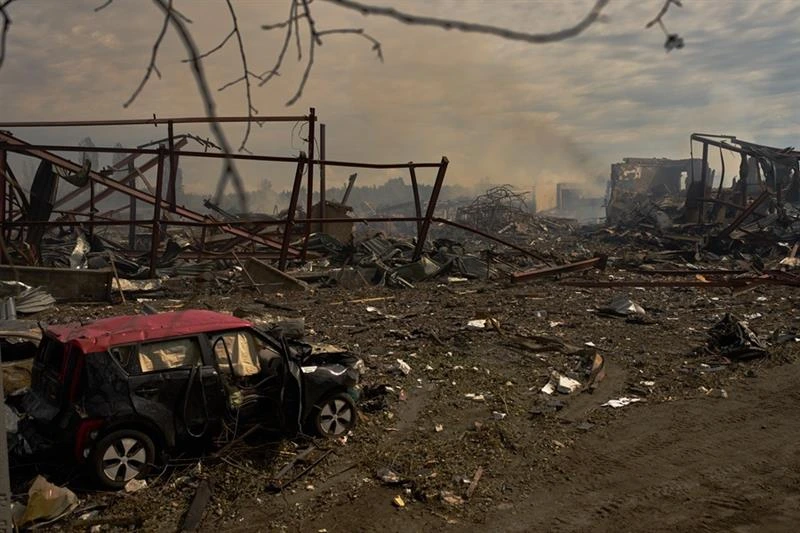
The war in Ukraine has taken another devastating turn after a Russian strike near Kyiv left 38 people dead, making it the deadliest single Russian attack in Ukraine so far this year. The attack, which struck a facility in the village of Myla west of the Ukrainian capital, triggered massive explosions and fires that spread into surrounding areas, damaging homes and other buildings and forcing hundreds of residents to evacuate.
The rising death toll has once again placed the human cost of the Russia-Ukraine war at the center of international attention. Ukrainian President Volodymyr Zelenskyy said 38 people had been killed, while 20 others were injured and four people remained missing as emergency crews continued rescue, firefighting, and cleanup operations.
The attack also comes as Russia appears to be intensifying its long-range campaign against Ukraine. Ukrainian officials say Moscow launched nearly 2,000 strike drones, more than 1,600 aerial bombs, and 31 missiles against Ukraine during the past week. At the same time, Russia has warned that it is preparing what it described as massive strikes against Ukrainian energy infrastructure.
The latest escalation has raised fears that the conflict could become even more dangerous as Ukraine approaches another difficult winter.
A Deadly Strike Near Kyiv
The attack occurred late on August 28 in Myla, a village in the Bucha district of the Kyiv region. Ukrainian officials said a Russian drone struck a facility storing ammunition, setting off a chain reaction of explosions.
The initial strike was followed by powerful detonations involving ammunition stored at the site. Fires spread through the area, damaging nearby residential buildings and other structures.
Emergency crews faced a dangerous situation because unexploded ordnance and other explosive materials remained in the area after the initial attack.
According to Ukrainian officials, hundreds of people were evacuated from the surrounding area as firefighters and rescue workers attempted to contain the damage. The Kyiv Independent reported that more than 380 people, including dozens of children, were evacuated following the explosions.
The scale of the destruction made the operation particularly difficult.
Instead of dealing with a single impact site, emergency workers had to contend with fires, debris, damaged structures, and the continuing risk of additional explosions.
Death Toll Rises to 38
The death toll initially increased as rescue workers searched through the damaged area.
By August 30, Zelenskyy said 38 people had been killed. Twenty others were injured, including children, while four people were still missing.
The final death toll could potentially change as search-and-rescue teams continue their work.
The tragedy has become one of the most serious single incidents in Ukraine this year and one of the deadliest attacks near Kyiv during the ongoing full-scale war.
For families in the affected community, the numbers represent much more than another statistic in a long-running conflict.
Each casualty represents a person with relatives, friends, colleagues, and a community that must now deal with the consequences.
Homes and Communities Caught in the Blast
The damage was not limited to the military facility.
The explosions affected nearby homes and other civilian structures, sending debris across surrounding areas and damaging buildings.
The Kyiv Independent reported that at least 130 residential buildings were damaged, while a facility serving elderly people and people with disabilities was also affected.
The incident highlights one of the most persistent dangers of the war: military targets and civilian communities can exist dangerously close to one another.
When a large ammunition storage facility is hit, the consequences can extend far beyond the original target.
The resulting explosions can destroy buildings, start fires, and send fragments across a wide area.
For residents living nearby, there may be little time to escape once an attack begins.
Questions About the Ammunition Facility
The attack has also created a political controversy inside Ukraine.
Ukrainian officials have raised questions about why significant quantities of ammunition were being stored so close to residential areas.
President Zelenskyy criticized the decision, while Ukrainian authorities launched investigations into whether officials were negligent in allowing the facility to operate in its location.
Ukraine has strict rules concerning the storage of military ammunition near populated areas.
The latest incident is especially sensitive because it follows another deadly explosion at an ammunition storage site in the Kyiv region earlier this year.
That has led to growing demands for accountability.
The debate is no longer simply about the Russian attack.
It is also about whether Ukrainian authorities took sufficient precautions to protect civilians from the secondary consequences of such an attack.
Ukraine Opens a Criminal Investigation
Ukrainian prosecutors have opened a criminal investigation into alleged negligence connected with the storage of ammunition.
That investigation could become a major political issue in the aftermath of the tragedy.
Officials are likely to face questions about who approved the location, whether safety standards were followed, and whether warnings from earlier incidents were properly addressed.
The investigation does not change responsibility for Russia’s attack, but it reflects another reality of wartime governance: governments must protect civilians not only from enemy attacks but also from preventable risks created by their own decisions.
Ukrainian Prime Minister Serhii Koretskyi has called for those responsible to be held accountable and criticized what he described as a repetition of previous mistakes.
For grieving families, accountability may become an important part of the recovery process.
Russia Says More Strikes Could Be Coming
The situation becomes even more concerning because Russia has indicated that further large-scale attacks may be ahead.
Russia’s Defense Ministry said it was preparing what it called massive strikes against Ukraine’s energy infrastructure.
Moscow presented the potential campaign as retaliation for Ukrainian attacks against Russian infrastructure, including energy and industrial facilities.
That warning has revived fears about another difficult winter for Ukraine.
During previous winters, Russian attacks on Ukraine’s power grid caused widespread electricity and heating disruptions.
Millions of Ukrainians have experienced blackouts and shortages of heat during freezing weather as Russia targeted energy infrastructure.
The possibility of another major campaign against power plants and other energy facilities is therefore particularly concerning as temperatures begin to fall.
Ukraine Is Also Increasing Its Long-Range Attacks
The escalation is not happening in only one direction.
Ukraine has increasingly used long-range drones to attack Russian military, energy, and industrial infrastructure.
Ukrainian officials argue that these operations are intended to weaken Russia’s ability to continue financing and supplying its war effort.
Russian officials have reported Ukrainian drone attacks on oil refineries and other facilities.
Reuters reported that Ukraine recently targeted an oil refinery in Russia’s Leningrad region, while Russian authorities said they intercepted hundreds of Ukrainian drones.
The expanding use of long-range weapons means that the geography of the war continues to change.
Neither side is limiting attacks to areas immediately adjacent to the front line.
Instead, infrastructure hundreds of miles away can become part of the conflict.
A War Increasingly Defined by Drones
One of the clearest developments in the Russia-Ukraine war has been the growing importance of drones.
Both countries have dramatically expanded their use of unmanned aircraft.
For Russia, drones provide a relatively inexpensive way to launch large numbers of attacks against Ukrainian cities, military facilities, infrastructure, and industrial sites.
For Ukraine, long-range drones have become an important tool for striking targets inside Russia.
This has created a cycle of escalation.
As one side develops new drone technologies, the other attempts to improve air defenses or develop more effective countermeasures.
The result is a war in which attacks can occur far from the traditional battlefield.
Russia’s Changing Attack Strategy
Ukrainian officials have warned that Russia is changing the way it conducts aerial attacks.
Some recent attacks have involved large numbers of drones launched over extended periods.
The use of jet-powered drones has also created new challenges for Ukrainian air defenses.
The Kyiv Independent reported that Ukrainian officials have been dealing with increasingly sophisticated Russian drone attacks that are more difficult to intercept.
That creates a serious problem for Ukraine.
Air-defense systems are expensive and limited, while Russia can potentially launch large numbers of relatively inexpensive drones.
This creates a difficult calculation for Ukrainian commanders: how to protect cities, power infrastructure, military facilities, and other critical sites when the number of incoming weapons can be enormous.
The Coming Winter Is a Major Concern
Winter has always been an important factor in the Russia-Ukraine war.
Ukraine’s cold climate means that electricity and heating are not simply conveniences. They are essential for survival.
A major attack on the power grid can therefore have consequences far beyond temporary blackouts.
Hospitals need electricity.
Water systems need power.
Homes need heating.
Businesses need functioning infrastructure.
Transportation systems depend on energy.
That is why Russia’s warning about potential attacks on energy infrastructure has generated concern among Ukrainian officials.
If Moscow launches another sustained campaign against the power grid, Ukrainian communities could face another difficult winter.
The Political Cost for Ukraine
The latest attack creates a difficult political situation for the Ukrainian government.
President Zelenskyy must continue presenting Ukraine as a country capable of defending itself against Russian aggression while also addressing legitimate questions about domestic security and military infrastructure.
The ammunition depot investigation could therefore become politically sensitive.
Opposition figures and critics may demand greater transparency about who authorized the facility and whether officials ignored existing safety requirements.
The government, meanwhile, must balance accountability with the reality that Ukraine is fighting a major war and requires ammunition and military infrastructure to defend itself.
That balance is extremely difficult.
The government cannot eliminate every risk associated with storing military equipment during wartime.
But it can be expected to minimize unnecessary risks to civilians.
That is why the investigation will matter.
The Human Cost Remains the Biggest Story
Political arguments can sometimes make war coverage feel abstract.
But the 38 deaths near Kyiv provide a painful reminder that the consequences are deeply human.
Families have lost loved ones.
Residents have lost homes.
Businesses have been damaged.
People have been forced to evacuate their communities.
Emergency workers have been placed in danger while trying to rescue others.
And those who survived must now live with the psychological consequences of the attack.
For people in Ukraine, the war is not a distant political debate.
It affects where they sleep, where their children go to school, whether they can safely travel, and whether they can rely on electricity and other basic services.
International Support Remains Crucial
The continuing escalation also puts pressure on Ukraine’s international partners.
Ukraine depends heavily on Western military, financial, and humanitarian support.
Air-defense systems are particularly important as Russia expands its drone and missile campaigns.
The country also needs ammunition, replacement equipment, financial assistance, and long-term reconstruction support.
At the same time, Ukraine’s allies face their own political pressures.
Governments in Europe and elsewhere must explain to their citizens why billions of dollars and euros are being committed to supporting Ukraine.
The longer the war continues, the more difficult those political debates may become.
The Search for a Diplomatic Solution
The latest escalation also raises another difficult question: how much longer can the war continue without a meaningful diplomatic breakthrough?
The conflict has now lasted years, and repeated rounds of negotiations have failed to produce a lasting peace agreement.
Both Russia and Ukraine continue to pursue military strategies designed to strengthen their positions.
That makes diplomacy extremely complicated.
Ukraine wants security guarantees and an end to Russian aggression.
Russia continues to demand conditions that Kyiv and its allies have rejected.
Meanwhile, civilians continue paying the price.
Every new wave of attacks makes the possibility of an immediate diplomatic resolution seem more distant.
A Dangerous Cycle of Retaliation
The current pattern resembles a cycle.
Russia launches attacks against Ukraine.
Ukraine responds with strikes against Russian military and industrial targets.
Russia threatens further retaliation.
Ukraine prepares for additional attacks.
The cycle continues.
Each escalation creates new opportunities for casualties and infrastructure destruction.
The risk is that the conflict becomes increasingly difficult to control.
Long-range weapons mean that attacks can affect areas far from the front line, while increasingly sophisticated drones can penetrate defenses that were once considered reliable.
The result is a war that continues to expand in technological and geographic complexity.
What Happens Next?
The immediate priority in Myla remains recovery.
Emergency crews must complete the search for missing people, remove dangerous debris, extinguish remaining fires, and help residents return safely.
At the same time, Ukrainian authorities will have to investigate the circumstances surrounding the ammunition facility.
Beyond the local tragedy, the country must prepare for the possibility of additional Russian attacks.
Russia’s warning about energy infrastructure means Ukrainian officials are already looking toward the coming winter.
The country will need to strengthen air defenses, protect critical infrastructure, repair damaged facilities, and maintain emergency power supplies.
Those preparations could become essential if Russia follows through on its threat of a new campaign against the energy grid.
Why This Attack Matters
The attack near Kyiv is significant for several reasons.
First, it is the deadliest single Russian attack in Ukraine so far in 2026, according to Ukrainian officials and international reporting.
Second, the strike demonstrates the destructive potential of modern drone warfare when ammunition storage facilities are involved.
Third, it has exposed a serious domestic political issue concerning the location and security of military facilities.
Fourth, it comes amid a broader escalation in long-range attacks by both Russia and Ukraine.
Finally, it raises concerns about what could happen as winter approaches and Russia considers renewed attacks against Ukraine’s energy system.
The incident is therefore more than another tragic event in a long war.
It is a warning about how quickly a single attack can produce consequences far beyond its intended target.
Ukraine’s War Enters Another Dangerous Phase
The death toll of 38 from the Russian strike near Kyiv is a grim reminder that the Russia-Ukraine war remains intensely dangerous.
The attack has devastated a community, killed dozens of people, injured others, and created new political questions for Ukraine’s leadership.
At the same time, Russia’s warning of possible large-scale attacks against Ukraine’s energy infrastructure suggests that the violence may intensify rather than diminish.
Ukraine is responding with its own long-range strikes against Russian infrastructure, meaning both sides continue to expand the reach of their military operations.
For civilians, however, the political and military calculations are secondary to survival.
They want their homes to be safe.
They want electricity and heating during winter.
They want their families protected.
And after years of war, many simply want the violence to end.
Final Thoughts
Ukraine’s latest tragedy shows how unpredictable and destructive the war has become.
A Russian strike on a facility near Kyiv triggered massive explosions, damaged surrounding communities, and left 38 people dead, with four others still missing as rescue operations continued.
The attack has also opened another political front inside Ukraine, with authorities investigating whether ammunition was stored too close to civilian areas and whether officials failed to learn from previous incidents.
Meanwhile, Russia is warning of further strikes against Ukraine’s energy infrastructure, while Ukraine continues expanding its own long-range drone campaign against targets inside Russia.
The result is a dangerous cycle of attack and retaliation with no obvious end in sight.
As Ukraine approaches another winter under wartime conditions, the pressure on its government, military, international allies, and civilians is likely to grow.
The tragedy near Kyiv is a reminder that behind every military strategy and political statement are real people living with the consequences.
For Ukraine, the challenge now is not only surviving the latest attack but preparing for what could come next.