
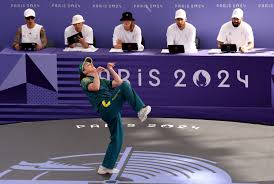
The internet has a long memory, but not in the way you might expect. It doesn’t preserve achievements with care or context; instead, it clings to moments that are easily repeatable, remixable, and emotionally charged. That’s why a single performance by Rachel Gunn—better known as Raygun—continues to echo across timelines long after the 2024 Summer Olympics have ended. Medals are recorded in history books. Memes, on the other hand, live in feeds, comment sections, and collective online memory, resurfacing again and again.
There is something almost paradoxical about this. The Olympics are designed to immortalize excellence. Athletes train for years, sometimes decades, for a moment that may last only minutes. Success is measured in fractions of seconds or points on a scoreboard. But outside the official results, another layer of judgment now exists—one that is faster, louder, and often more influential in shaping public perception. That layer belongs to the internet, where recognition is less about formal achievement and more about cultural impact.
Raygun’s performance entered that layer almost instantly. Clips circulated widely on platforms like TikTok and X, stripped of commentary and presented as standalone moments. For many viewers, this was their first exposure to Olympic breaking, and without context, interpretation defaulted to instinct. Some found it confusing, others humorous, and many reacted in ways that prioritized entertainment over understanding. The result was a wave of attention that had little to do with competitive scoring and everything to do with virality.
What keeps the conversation alive isn’t just the original moment, but the questions that followed—and continue to follow. People still ask how she qualified, whether the judging criteria were misunderstood, and what the performance was intended to convey. These questions aren’t always asked in good faith, but their persistence reveals something deeper about how the internet processes unfamiliar forms of expression. When audiences encounter something outside their expectations, the instinct is often to interrogate rather than explore.
This is where meme culture plays a decisive role. Memes simplify. They take complex situations and distill them into easily digestible, repeatable formats. In doing so, they create a shared language that allows millions of people to participate in a conversation with minimal effort. But that simplification comes at a cost. The more a moment is memefied, the further it drifts from its original context. In Raygun’s case, the performance became less about breaking as an art form and more about a single, looping image that could be captioned, edited, and reshared indefinitely.
What’s striking is how durable that image has proven to be. Internet cycles are often described as קצר—fast-moving, constantly shifting—but certain moments manage to stick. They become reference points, shorthand for a particular kind of reaction. Raygun’s performance has taken on that quality. Even as new trends emerge, her name still appears in discussions about viral Olympic moments, often accompanied by the same clips that first circulated months earlier.
Part of this endurance comes from the nature of the content itself. Memes thrive on ambiguity and exaggeration, and her performance provided both. It was open to interpretation, which allowed different audiences to project their own meanings onto it. At the same time, the reactions it generated—laughter, confusion, disbelief—were strong enough to fuel continued sharing. In the economy of attention, that combination is powerful.
Another factor is the participatory nature of internet culture. Once a moment goes viral, it doesn’t remain static. It evolves as users create their own versions, adding layers of commentary and humor. Each remix extends the lifespan of the original, keeping it in circulation even as the context fades. In this sense, the internet doesn’t just remember; it actively reconstructs memory in real time.
For Raygun, this has meant living with a narrative that is constantly being revisited and reinterpreted. The recent resurgence tied to her presence on Cameo shows how these cycles can reignite. What might have been a closed chapter becomes relevant again, not because of new information, but because the existing narrative is reactivated. The internet doesn’t need a new event to revisit an old story; it only needs a reason to look again.
There is also an underlying tension between expertise and mass perception that continues to fuel the conversation. Breaking, like many specialized disciplines, has its own standards and criteria that may not align with general audience expectations. When those standards are not widely understood, the gap is often filled with speculation. This is why questions about judging and qualification persist. They are attempts—sometimes genuine, sometimes not—to reconcile what was seen with what is assumed about Olympic competition.
At the same time, the persistence of these questions highlights a broader shift in how authority is perceived. In the past, official results and expert commentary would have carried more weight in shaping public opinion. Today, those voices compete with millions of individual perspectives, each amplified by algorithms that prioritize engagement. The result is a more fragmented understanding of events, where multiple narratives can coexist, even if they contradict each other.
This fragmentation is not inherently negative. It allows for a diversity of viewpoints and interpretations. But it also creates an environment where misinformation and oversimplification can thrive. When a performance is reduced to a meme, the opportunity for deeper engagement diminishes. The conversation becomes less about learning and more about reacting.
And yet, there is a certain inevitability to all of this. The internet is not designed to function like an archive or a classroom. It is designed to capture attention, to facilitate interaction, and to keep users engaged. Within that framework, moments like Raygun’s performance are almost destined to become cultural artifacts—not because of their original intent, but because of how they are received and repurposed.
What makes her story resonate is that it feels both specific and universal. It is about one person, one performance, one moment in time. But it is also about a system that can take any moment and transform it into something else entirely. The details may change, but the pattern remains consistent: visibility leads to interpretation, interpretation leads to amplification, and amplification leads to a kind of permanence that is difficult to escape.
The phrase “memes last longer than medals” captures this dynamic in a way that is both succinct and unsettling. Medals are tangible, official, and finite. They represent a clear outcome within a defined system. Memes, by contrast, are fluid, unofficial, and potentially infinite. They exist as long as people continue to share and engage with them, which can be far longer than the lifespan of any single event.
For athletes, this introduces a new dimension to competition. It is no longer just about performance within the arena; it is also about how that performance will be perceived and circulated outside of it. This is not something that can be fully controlled or anticipated, but it is an increasingly important part of the landscape.
At the same time, it would be a mistake to view this solely as a negative development. The same mechanisms that produce infamy can also create opportunities. Visibility, even when it is complicated, can open doors that might not have existed otherwise. The key lies in how that visibility is navigated. Raygun’s decision to engage with her audience through Cameo suggests an understanding of this reality. Rather than attempting to erase the narrative, she is finding ways to exist within it.
Still, the lingering questions remain a testament to the internet’s unresolved curiosity. People are not just consuming the meme; they are interrogating it, debating it, and revisiting it. This ongoing engagement is what keeps the story alive. It is not a static piece of content, but a dynamic conversation that continues to evolve.
In the end, the persistence of Raygun’s viral moment says as much about the audience as it does about the performance itself. It reveals a tendency to latch onto the unusual, to question what doesn’t immediately make sense, and to turn those questions into shared cultural experiences. It also underscores the power of the internet to shape narratives in ways that extend far beyond their original context.
Medals may define an athlete’s official legacy, but in the digital age, they are only part of the story. The rest is written in posts, comments, and clips that circulate long after the event has ended. For Raygun, that story is still being told, one meme at a time, as the internet continues to ask its questions—and to keep her moment alive in ways that no podium ever could.
 Mark Shlart