
October is barely underway, and Hollywood is already behaving like somebody accidentally pressed the “maximum drama” button. The month has delivered fashion spectacles, unexpected celebrity appearances, viral reactions, movie premieres, television moments, social-media debates and enough celebrity sightings to keep multiple group chats operating at full capacity. Normally, the beginning of a new month is supposed to feel like a reset. In Hollywood, apparently, it is simply an invitation to bring all the existing chaos into a new calendar page and add a few fresh storylines.
The first week of October has demonstrated just how quickly celebrity culture can accelerate. Paris Fashion Week alone turned the beginning of the month into a parade of famous faces, designer looks and internet commentary. Jennifer Lopez, Rihanna, Jennifer Lawrence, Shakira, Heidi Klum, Janelle Monáe, Paris Jackson and numerous other stars appeared around the fashion circuit, giving entertainment audiences a seemingly endless supply of photographs and moments to analyze. PEOPLE’s October celebrity coverage made one thing very clear: Hollywood did not exactly ease into the month. It arrived loudly, dressed expensively and apparently ready for everyone to have an opinion.
Fashion Week has always been about clothes, but celebrity culture has transformed it into something much larger. A designer may unveil an entire collection, yet the online conversation can become dominated by one celebrity arrival. The outfit gets photographed from every possible angle. Fans decide whether the look is brilliant or disastrous. Fashion accounts analyze the styling. Gossip accounts examine who the celebrity was sitting beside. Then the celebrity’s appearance becomes a headline in its own right. Suddenly, a runway presentation is no longer just a fashion event. It is another chapter in the never-ending Hollywood content machine.
Rihanna’s Paris appearance demonstrated how quickly a celebrity fashion moment can develop additional drama. Her attendance at Dior attracted attention, but online discussion surrounding the timing of her arrival created another layer of conversation. Rihanna appeared to respond to criticism through social media, which then generated another round of entertainment coverage. The sequence was almost perfectly representative of 2026 celebrity culture: celebrity appears, internet reacts, celebrity responds, internet reacts again, and everyone suddenly has another reason to discuss the original appearance.
And that is only one fashion-week storyline.
The celebrity calendar has also been packed with film premieres, which means Hollywood has been able to switch almost immediately from runway drama to red-carpet drama. October’s movie schedule has brought stars back into the spotlight at precisely the moment the entertainment industry is moving into one of its busiest periods. Instead of giving audiences time to recover from awards-season coverage, Hollywood has essentially replaced one celebrity cycle with another. The stars who dominated Emmy conversations are now sharing attention with actors promoting new films, streaming projects and fall releases.
The premiere circuit is particularly effective at generating multiple stories from one night. There is the film itself, the cast, the reviews, the red carpet, the fashion, the celebrity interactions, the interviews and the inevitable social-media reaction. A single premiere can produce enough material to fill an entertainment feed for days. PEOPLE’s early-October coverage included Ben Affleck and Kerry Washington at the Los Angeles premiere of Animals, while Anne Hathaway and other stars continued appearing around the promotional circuit for Verity.
Anne Hathaway’s recent promotional appearances are a good example of how celebrity publicity now works across multiple platforms. An actor promoting a film can appear at a premiere one day, attend a fashion event the next, appear on television after that and then become the subject of a viral clip or photo. The movie remains the underlying reason for the visibility, but the celebrity becomes the story people follow between each promotional event.
That is why Hollywood’s “drama budget” seems to disappear so quickly. The industry has become exceptionally efficient at turning one appearance into five different pieces of entertainment content.
The same thing is happening on television. The 2026 fall season is bringing new shows, returning favorites and major guest appearances into the public conversation, creating another stream of celebrity moments just as film promotion intensifies. The result is a crowded entertainment calendar in which audiences barely finish discussing one event before another arrives.
And then there are the social-media surprises.
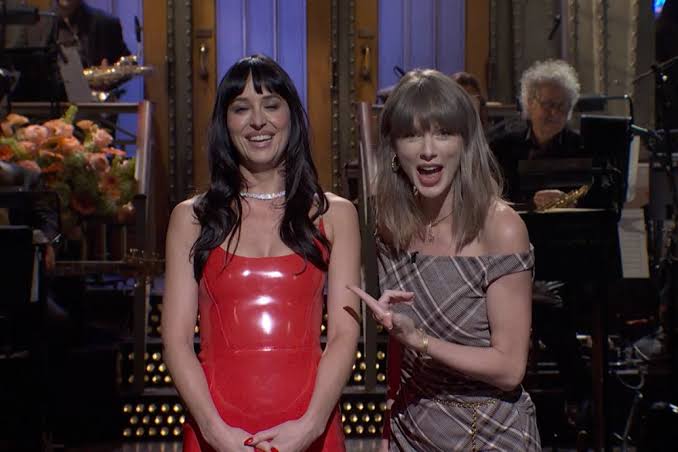
Taylor Swift’s appearance during Dakota Johnson’s Saturday Night Live monologue became an instant example of how a celebrity cameo can create a completely separate conversation. Swift’s unexpected appearance was funny, brief and highly shareable, which made it ideal internet material. The cameo also included a reference to Travis Kelce, giving fans another detail to discuss. Variety reported on the surprise appearance and the way it became one of the night’s major talking points.
This is modern Hollywood’s secret weapon: surprise.
Audiences have become accustomed to planned publicity. They know celebrities will walk red carpets. They know actors will appear on late-night television. They know musicians will attend fashion shows. But when a famous person unexpectedly appears somewhere, the event feels different. It creates the illusion that audiences are witnessing something spontaneous, even when the appearance is part of a carefully coordinated entertainment strategy.
That distinction matters because surprise generates urgency. If people think something might disappear from the conversation quickly, they are more likely to click, share and comment immediately. Social media rewards that behavior. The faster audiences react, the faster the story spreads.
Hollywood understands this perfectly.
But not every October storyline is harmless fun. The same platforms that turn fashion and cameos into entertainment can also turn serious issues into enormous public debates. Celebrity activism, controversial statements and legal developments can rapidly become part of the entertainment news cycle, particularly when a famous person decides to speak publicly.
Florence Pugh’s recent comments surrounding the Cornell sexual-assault case are an example of how a celebrity post can develop into a much larger story. Pugh used social media to express her anger and concern, and her posts became part of a wider discussion involving other celebrities and the response to the allegations. Variety reported on Pugh’s subsequent television appearance and her criticism of Instagram after one of her posts received a content warning.
The subject matter is obviously much more serious than fashion or premiere gossip, but the underlying mechanics of the modern celebrity news cycle remain the same. A public figure speaks. People react. Other public figures respond. Media outlets report on the reactions. Social media continues the conversation. Each new response becomes another headline.
Hollywood therefore exists in a state of permanent reaction.
The internet does not necessarily need a new event. It can keep an old event alive by finding another angle. Someone discovers an old interview. Someone compares two outfits. Someone notices that two celebrities stopped following each other. Someone revisits a controversial statement. Someone posts an edited video. Someone disagrees with the original reaction. And suddenly yesterday’s story has returned with a new lease on life.
October is particularly good at this because it sits at a strange point in the entertainment calendar. Awards season has recently produced its biggest television conversations, while the fall movie season is gaining momentum and fashion is moving into another major phase. At the same time, Halloween season is beginning to influence celebrity culture, which means costumes, parties, themed events and increasingly elaborate social-media posts are waiting around the corner.
In other words, Hollywood has not even reached the fun part yet.
The Halloween celebrity cycle could provide an entirely new category of chaos. Every year, famous people compete to create the most memorable costume, whether through elaborate transformations, nostalgic references, couples costumes or intentionally provocative looks. Social media then turns those costumes into rankings. Who won? Who disappointed? Who copied whom? Who understood the assignment? Who absolutely did not?
By late October, the internet will likely be running multiple simultaneous celebrity debates about costumes while also discussing movies, music, fashion and relationships.
The drama budget is not merely overspent.
It is in danger of being completely eliminated.
Another reason October feels particularly chaotic is that celebrities are increasingly comfortable using social media as their own publicity channel. Instead of waiting for entertainment reporters to photograph them, stars can directly create images, statements and announcements for their audiences. That can make celebrity culture feel more immediate, but it also means the boundary between personal life and publicity becomes harder to identify.
A carefully chosen Instagram photograph can be both a personal post and a marketing strategy. A casual-looking video can promote a product. A behind-the-scenes photograph can generate interest in an upcoming project. A joke can become a headline. A response to criticism can become another headline. Even silence can become part of the narrative.
This creates a peculiar situation in which celebrities are simultaneously controlling and losing control of their own stories. They have more tools than ever to communicate directly with fans, but they also have less ability to determine how those messages will be interpreted once they enter the wider internet.
That is why one celebrity post can produce an entire day’s worth of discourse.
And Hollywood has no shortage of celebrities willing to provide the material.
The first week of October has already included enough public appearances to demonstrate the sheer scale of the modern celebrity ecosystem. Paris Fashion Week brought stars from music, film and television together. Film premieres brought actors onto red carpets. Television appearances created viral clips. Social-media posts generated new conversations. Entertainment publications documented the entire process in real time.
The result is a cultural environment where there is almost always something happening.
Even when nothing happens.
That may be the funniest part.
A celebrity can simply exist in public and become news. They can walk into a restaurant. They can attend a basketball game. They can sit front row at a fashion show. They can leave an airport. They can be photographed with a friend. None of these activities necessarily constitute major events, yet each one can become a headline because audiences remain fascinated by famous people doing ordinary things.
Hollywood has essentially transformed normal human behavior into premium content.
And once the internet notices, it is almost impossible to look away.
Of course, the constant stream of celebrity stories has created a strange form of audience fatigue. People complain that there are too many headlines, too many controversies and too many people arguing about things that do not matter. Then those same people click the next story. They send it to a friend. They post their opinion. They quote someone else’s opinion. They ask why everyone is talking about it.
And there it is again.
Another conversation.
Another headline.
Another reason the group chat has to be opened.
This is why the idea that Hollywood has already used up October’s drama budget feels less like an exaggeration and more like a warning. The month has only just begun, but the entertainment industry has already supplied enough material for fashion debates, celebrity sightings, movie discussions, social-media arguments, viral moments and cultural commentary.
There is still an entire month ahead.
There are more premieres. More television episodes. More fashion moments. More interviews. More celebrity birthdays. More unexpected appearances. More social-media posts. More Halloween parties. More red carpets. More opportunities for someone to say something that causes the internet to collectively stop what it is doing and announce, once again, that “we need to talk about this.”
And honestly, Hollywood would probably not have it any other way.
Because in the modern entertainment economy, attention is the real currency. A celebrity moment that generates conversation has value. A controversial photograph has value. A viral interview clip has value. A memorable outfit has value. Even an argument about whether something deserves attention can generate enough engagement to keep the story alive.
So if October already feels chaotic, there is probably a reason.
Hollywood has figured out that the best way to keep people watching is to never give them a clean ending.
One story becomes another.
One appearance becomes a headline.
One headline becomes a debate.
One debate becomes a meme.
And before anyone has time to recover, somebody else walks onto another red carpet wearing something completely unexpected.
October has barely started.
The group chats are already tired.
Hollywood, apparently, is just getting warmed up.
Caption: October just started and Hollywood has already exceeded its monthly drama allowance.
References
PEOPLE — Celebrity Star Tracks: October 4, 2026
PEOPLE — Best Celebrity Looks of the Week
PEOPLE — Celebrity Sightings: October 3, 2026
PEOPLE — Celebrity Sightings: October 2, 2026
Variety — Taylor Swift’s Saturday Night Live Cameo
Variety — Florence Pugh and the Cornell Case
 Mark Shlart