
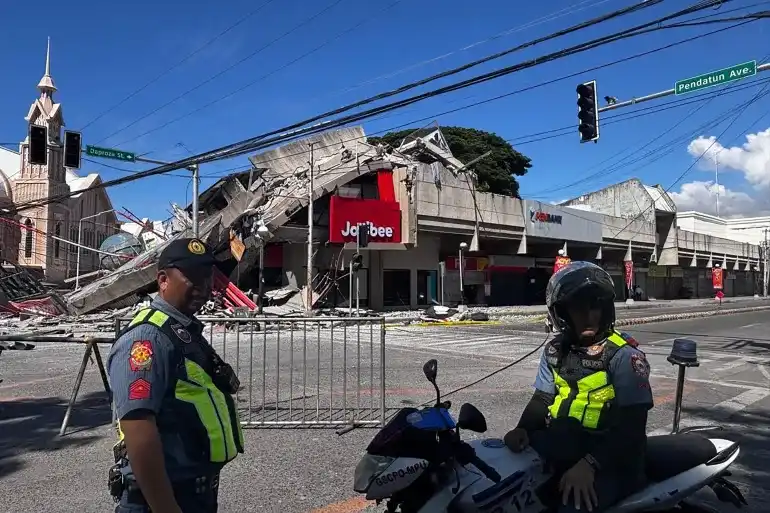
A powerful and destructive earthquake struck the southern Philippines, triggering tsunami alerts across multiple countries in Asia and sending shockwaves through coastal communities across the Pacific region. The earthquake, recorded at a magnitude above 7.5 by international seismic monitoring agencies, hit offshore near Mindanao and caused widespread panic, structural damage, and emergency evacuations across affected regions.
Authorities confirmed that the earthquake originated from a shallow underwater fault line, a condition that significantly increases the intensity of ground shaking and the potential for tsunami formation. Within minutes of the quake, tsunami warning systems were activated across the Philippines and neighboring countries, placing millions of residents on high alert.
This developing disaster has once again highlighted the Philippines’ vulnerability to seismic activity due to its location along the Pacific Ring of Fire, one of the most geologically active regions in the world.
Earthquake Strikes Offshore Mindanao With Violent Tremors
The earthquake struck offshore in the waters near Mindanao, a region in the southern Philippines known for frequent seismic activity. According to initial reports from global monitoring agencies, the quake occurred at a shallow depth, which amplified the intensity of shaking felt on land.
Residents in cities such as General Santos, Davao, and nearby provinces reported violent tremors that lasted for several seconds. Many described the shaking as sudden and forceful, causing people to rush out of homes, schools, offices, and shopping centers in panic.
In urban areas, buildings swayed noticeably, while older structures sustained visible damage. Cracks appeared in walls, glass windows shattered, and in some locations, ceilings collapsed under pressure from the intense ground movement.
The Philippine Institute of Volcanology and Seismology confirmed that the quake was tectonic in origin, caused by the movement of plates beneath the ocean floor. Experts immediately warned of possible aftershocks, some of which could still reach damaging levels in the hours and days following the main quake.
Tsunami Alerts Issued Across Asia and the Pacific
Within minutes of the earthquake, tsunami warning centers across the Asia-Pacific region issued alerts due to the underwater location of the epicenter. The Pacific Tsunami Warning Center began monitoring sea level changes and potential wave propagation across the ocean.
Coastal regions in the Philippines were placed under immediate evacuation orders. Residents in low-lying areas were instructed to move to higher ground or designated evacuation centers. Sirens sounded in several coastal towns, while mobile emergency alerts were sent to millions of phones across the region.
Neighboring countries including Indonesia, Malaysia, Japan, and parts of the Pacific islands also issued precautionary tsunami advisories. Although not all areas experienced significant wave activity, authorities emphasized that even distant tsunamis can travel across oceans and arrive hours after an earthquake.
In some coastal areas, minor sea level fluctuations were recorded, but no large-scale destructive tsunami waves have been confirmed at the time of reporting.
Casualties, Injuries, and Human Impact
As emergency response teams reached affected areas, authorities confirmed that the earthquake resulted in casualties and numerous injuries. Many of the deaths were caused by collapsing structures, falling debris, and accidents during evacuation.
Hospitals in southern Mindanao reported being overwhelmed as injured residents were brought in for treatment. Medical teams worked continuously to stabilize patients suffering from fractures, head injuries, and trauma-related conditions.
Emergency shelters were quickly set up in schools, sports centers, and public buildings to accommodate displaced families. Thousands of residents were forced to leave their homes, uncertain whether returning would be safe due to structural instability and ongoing aftershocks.
Officials warned that the number of casualties could change as search-and-rescue operations continue in remote and heavily damaged areas.
Structural Damage and Infrastructure Collapse
The earthquake caused widespread structural damage across multiple provinces in Mindanao. Buildings in both urban and rural areas suffered varying degrees of destruction, with some structures collapsing entirely.
Commercial centers, residential homes, and public facilities were among the hardest hit. In some towns, entire blocks experienced power outages and communication failures, making it difficult for residents to contact emergency services.
Transportation infrastructure was also affected. Roads developed large cracks, bridges were temporarily closed for inspection, and some highways became impassable due to debris and ground displacement.
Utility services such as electricity and water supply were disrupted in several regions, forcing authorities to deploy emergency repair teams to restore basic services.
Philippines’ Location in the Pacific Ring of Fire
The Philippines is located in the Pacific Ring of Fire, a massive seismic belt that surrounds the Pacific Ocean and is responsible for most of the world’s earthquakes and volcanic eruptions.
This geological positioning makes the country highly vulnerable to earthquakes and tsunamis. The movement of tectonic plates beneath the region creates constant seismic pressure, which is periodically released in the form of earthquakes.
Because of this, the Philippines experiences frequent seismic activity ranging from minor tremors to major destructive earthquakes. Scientists continuously monitor fault lines and underwater seismic zones in an effort to improve early warning systems.
However, despite advances in technology, precise earthquake prediction remains impossible, making preparedness and rapid response the most important tools for saving lives.
Regional Tsunami Monitoring and International Response
Following the earthquake, seismic monitoring agencies across Asia and the Pacific closely tracked ocean activity for potential tsunami waves. Countries such as Indonesia, Japan, Australia, and Pacific island nations activated emergency monitoring systems.
In some regions, temporary evacuation orders were issued as a precaution before being lifted once no major tsunami waves were detected. This coordinated response reflects the importance of international cooperation in managing large-scale natural disasters.
Experts noted that even moderate earthquakes can trigger tsunami alerts across multiple countries due to the speed at which seismic waves travel underwater.
Aftershocks and Continuing Risks
Seismologists confirmed that aftershocks are expected to continue following the main earthquake. These secondary tremors are common after major seismic events and can sometimes cause additional damage, especially to already weakened structures.
Residents in affected areas were advised to remain cautious and avoid entering damaged buildings. Emergency agencies also warned of potential landslides in mountainous regions due to ground instability.
Authorities continue to monitor seismic activity closely as part of ongoing disaster response efforts.
Government Response and Emergency Operations
The Philippine government activated national disaster response protocols immediately after the earthquake struck. Emergency response teams, military units, and local government agencies were deployed to assist in rescue operations and provide humanitarian aid.
Evacuation centers were established to provide temporary shelter, food, clean water, and medical assistance to displaced families. Search-and-rescue operations were prioritized in heavily affected areas where survivors may still be trapped under debris.
Officials emphasized that coordination between national and local agencies is critical in managing large-scale disasters of this magnitude.
Public Reaction and Social Media Reports
As news of the earthquake spread, residents across the Philippines shared real-time updates through social media platforms. Videos showing strong shaking, damaged buildings, and evacuation scenes quickly circulated online.
While social media helped spread awareness rapidly, authorities also warned against misinformation and urged the public to rely only on official government sources for updates.
The emotional impact of the disaster was evident, with many residents expressing fear, shock, and concern for loved ones in affected regions.
Economic and Long-Term Impact
Beyond immediate destruction, the earthquake is expected to have economic consequences for affected regions. Damage to infrastructure, disruption of business activity, and emergency response costs will place additional strain on local economies.
Agricultural areas may also suffer losses due to damaged land and disrupted supply chains. Reconstruction efforts could take months or even years depending on the severity of structural damage.
Experts note that disasters of this scale often highlight the need for stronger building codes, improved urban planning, and better disaster preparedness strategies.
Conclusion
The powerful earthquake that struck the Philippines and triggered tsunami alerts across Asia represents one of the most significant seismic events in the region in recent times. While emergency systems helped prevent even greater loss of life, the disaster has still caused casualties, widespread damage, and regional disruption.
As aftershocks continue and recovery efforts begin, the focus remains on saving lives, restoring infrastructure, and supporting affected communities.
This event serves as a powerful reminder of the Philippines’ vulnerability to natural disasters and the importance of preparedness, early warning systems, and international cooperation in reducing the impact of future seismic events.
Citation Links Section
- Reuters – Philippines earthquake triggers tsunami alerts
- Associated Press – Strong earthquake hits Mindanao
- Philippine Institute of Volcanology and Seismology (PHIVOLCS)
- US Geological Survey Earthquake Data
- Pacific Tsunami Warning Center
- BBC News Asia – Earthquake coverage
 Jenn Sass