
Introduction: Two Incidents That Sparked National Attention
Chemical tank disasters in the United States are rare, but when they do occur, they often trigger widespread concern due to their potential for catastrophic environmental and human damage. Recent events in Washington State and California have once again brought industrial safety into focus, raising questions about how such incidents still happen despite strict regulations.
In Washington, a chemical tank rupture at a paper mill resulted in multiple fatalities and serious injuries. In California, a separate emergency involving an overheated chemical tank forced mass evacuations as officials feared a possible explosion. Although both incidents were alarming, experts emphasize that they are exceptions in an otherwise highly regulated industrial system.
Even with these high-profile events, data shows that large-scale chemical tank disasters remain uncommon across the United States, where thousands of facilities operate daily under strict safety standards
Washington State Disaster: How the Incident Unfolded
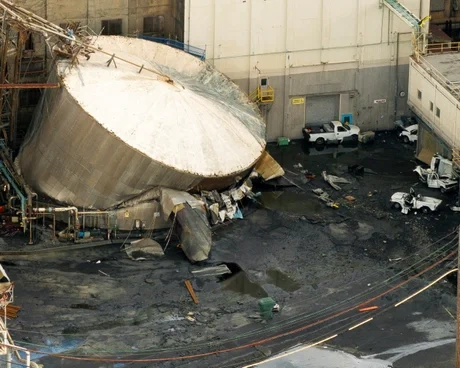
The most severe recent case occurred in Longview, Washington, at a paper manufacturing facility where a large chemical storage tank suddenly ruptured during operations. The tank contained a highly caustic substance used in industrial processing, and its failure resulted in a sudden and dangerous release of material.
Emergency responders arrived quickly, but the magnitude of the rupture made containment extremely difficult. The incident resulted in multiple confirmed fatalities and several injuries, with rescue operations transitioning into recovery efforts as the situation became more severe than initially reported
Subsequent reporting confirmed additional casualties as investigators worked to determine the exact cause of the structural failure. Officials also noted that the tank involved was significantly larger than initial estimates, raising concerns about industrial oversight and safety verification procedures
California Near-Miss: A Disaster Avoided
Just days before the Washington incident, Southern California experienced a serious chemical emergency in Garden Grove. A pressurized tank at an aerospace-related facility began overheating and releasing vapors, prompting authorities to issue evacuation orders for tens of thousands of residents.
Fire officials warned that if pressure systems failed completely, the tank could have exploded, posing a severe threat to surrounding communities. Emergency teams worked quickly to stabilize the system and prevent escalation, ultimately avoiding what could have become a major industrial disaster
Although the immediate danger was contained, authorities maintained evacuation precautions for some time as a safety measure while monitoring the stability of the system
Why Chemical Tank Disasters Remain Rare in the United States
Despite these incidents, experts consistently point out that chemical tank disasters remain rare relative to the scale of industrial activity in the United States. Thousands of chemical storage facilities operate daily, and only a very small percentage experience serious failures.
Industry data suggests that major chemical accidents are uncommon due to the presence of strict federal regulations, advanced engineering controls, and continuous safety monitoring systems
One of the main reasons for this low incidence rate is the strength of regulatory oversight. Agencies such as OSHA, the EPA, and PHMSA enforce strict requirements for chemical storage, handling, and transportation. In addition, modern industrial tanks are designed with multiple layers of protection, including pressure relief systems and automatic shutdown mechanisms.
Routine inspections and mandatory safety audits further reduce the likelihood of catastrophic failures. Emergency response teams also play a critical role, as rapid intervention often prevents small incidents from escalating into large-scale disasters.
Causes Behind Chemical Tank Failures
Even with strong safety systems in place, failures can still occur under specific conditions. Equipment degradation is one of the most common contributing factors, as tanks may weaken over time due to corrosion, structural fatigue, or long-term exposure to chemical substances.
Human error also remains a significant risk factor, particularly in areas involving maintenance procedures, operational oversight, or delayed response to warning signals. In other cases, temperature and pressure instability can lead to dangerous conditions if safety systems malfunction or fail to activate in time.
Transportation and handling processes introduce additional risks, especially when hazardous chemicals are moved between facilities. Each stage of transfer creates potential points of failure that must be carefully managed.
Environmental and Human Impact of Chemical Incidents
When chemical tank disasters do occur, the consequences can be severe and long-lasting. In Washington, the rupture resulted in fatalities and raised concerns about chemical exposure and environmental contamination due to the release of a highly caustic industrial substance
In California, although a full-scale disaster was avoided, the emergency still required the evacuation of tens of thousands of residents due to the risk of toxic vapor exposure and potential explosion
Environmental consequences of such incidents can include soil contamination, water pollution, air quality risks, and long-term ecological damage that may take years to fully assess and remediate.
Oversight and Regulatory Framework in the United States
Chemical safety in the United States is governed by multiple federal agencies, including the Environmental Protection Agency, the Occupational Safety and Health Administration, the Pipeline and Hazardous Materials Safety Administration, and the U.S. Chemical Safety Board.
These agencies work together to regulate industrial operations, enforce compliance, and investigate major incidents. However, experts note that regulatory complexity and aging infrastructure can still create gaps in oversight, particularly in older facilities or privately operated industrial sites.
Why Public Perception Feels Different from Reality
Although statistical data confirms that chemical tank disasters remain rare, public perception often suggests otherwise. This is largely due to increased media coverage, social media amplification, and the visual intensity of evacuation events and industrial accidents.
When multiple incidents occur within a short period, it can create the impression of a growing crisis, even if long-term trends remain stable. Experts caution that perception does not always reflect actual risk levels.
Lessons From Recent Incidents
The Washington and California incidents highlight several important lessons for regulators and industry operators. Aging infrastructure requires continuous modernization, and early detection systems must be improved to prevent unexpected failures. Emergency response speed remains critical in minimizing casualties, while transparent communication with the public is essential during crisis situations.
Near-miss events, such as the California case, are particularly valuable because they expose vulnerabilities without resulting in catastrophic loss of life, allowing systems to be improved proactively.
Conclusion: Rare But Serious Risks Require Ongoing Vigilance
Chemical tank disasters remain rare in the United States due to strong safety regulations, advanced engineering systems, and effective emergency response frameworks. However, recent incidents demonstrate that risks still exist, particularly in aging industrial infrastructure.
The Washington tragedy underscores the potential severity of structural failures, while the California near-miss shows how close modern systems can come to disaster if safeguards are not fully effective.
Experts agree that while the system is generally effective, continued investment in safety technology, infrastructure upgrades, and regulatory oversight is essential. The goal is not only to maintain rarity but to further reduce the likelihood of future catastrophic chemical tank failures.
Citations
- The Guardian – US chemical tank incidents overview
- Reuters – Washington chemical tank rupture report
- The Guardian – Washington paper mill implosion update
- Washington Post – California chemical tank emergency
- PBS News – California tank explosion risk update
 Jenn Sass